

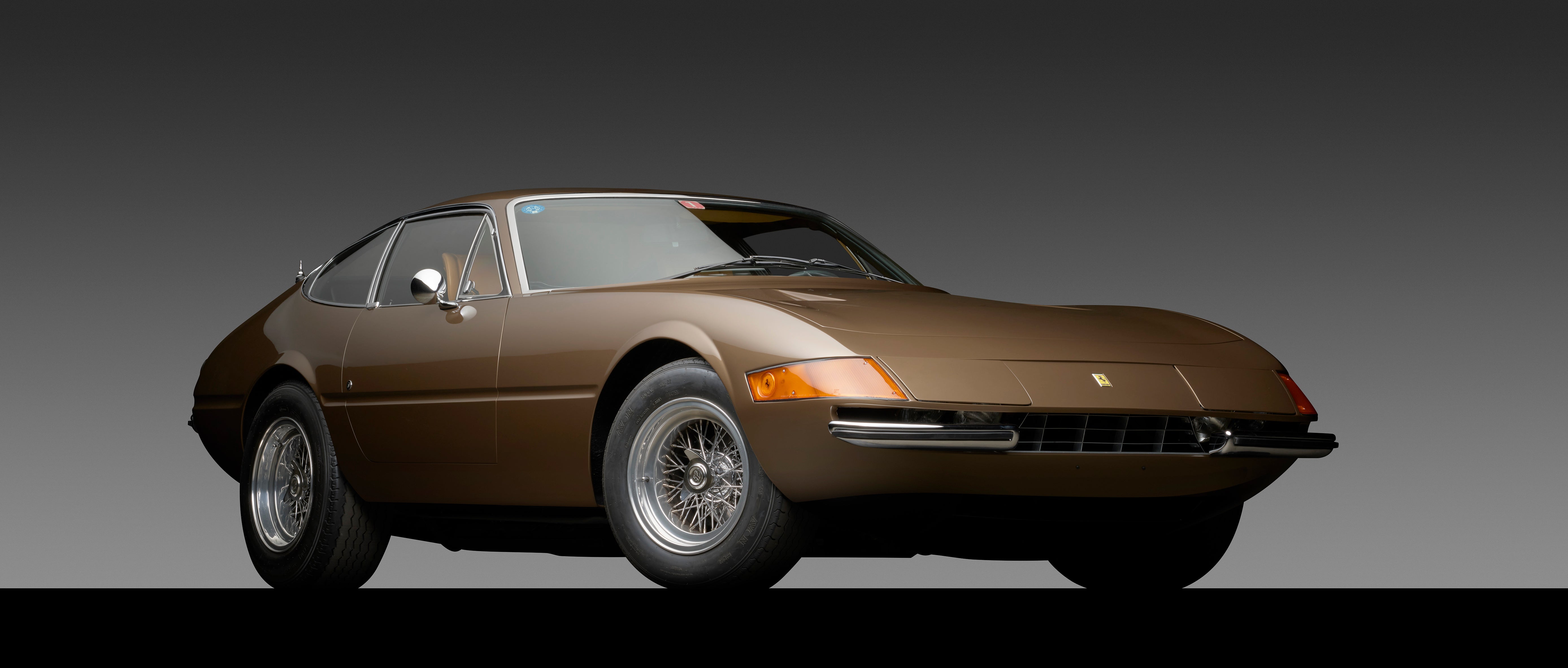
Ferrari Daytona in detail - Cutting edge technology
By Andrew Noakes
When the Ferrari Daytona was launched in 1968 it incorporated technology that was at the cutting edge in Formula 1 and endurance racing. To celebrate the release of Ultimate Ferrari Daytona, the definitive two-volume history.
Here’s our look at 5 of the most fascinating Daytona details:
#1 The Wheels
Wire-spoke wheels were common on sports and GT cars in 1968, so the Daytona’s five-spoke alloys were strikingly modern.
They were centre-lock wheels with a three-eared spinner, echoing Ferrari’s practice in F1 since the mid-1960s. A simple, minimal design, in contrast to the fussier Campagnolo alloys, which had been available on the 275. Similar wheels would be used on later Ferraris such as the 365 BB.

#2 The Four Cams
Twin camshafts on each bank of cylinders ensure that the valves could be ideally placed on either side of the combustion chamber for optimum efficiency. Two banks of cylinders, each one with two cams, made this a four-cam engine – denoted by the ‘/4’ in the 365 GTB/4 designation. It was technology used by Ferrari’s race engines in Formula 1 and endurance racing, and introduced to the company’s road cars in the 275 GTB/4 of 1966, but four cam engines in road cars were still rare in ’68.

#3 The Long Block
The Daytona’s engine had its roots in Ferrari’s first engine, a 1.5-litre V12 designed by Gioacchino Colombo for the 125 S in 1947. It was designed for expansion and by 1964 Ferrari was using basically the same engine in 3.3-litre form in the 275 GTB. A redesign of the block then made more space to accommodate wider bores and a longer stroke. This so-called ‘long block’ meant the Daytona engine could have a capacity of 4.4-litres, and developed 352bhp.

#4 Its Aero Shape
Leonardo Fioravanti proposed a striking modern new shape for the Daytona to replace the old fashioned 275 GTB. It was a cleaner and simpler shape, with an air-cleaving shovel nose, reflecting Fioravanti’s background as an aerodynamicist. Clever, subtle detailing like the wedge-shaped indicators and the groove along the side of the body helped to make it one of the most attractive and memorable Ferraris of all.

#5 Pininfarina
Pininfarina badges adorn the Daytona’s flanks, as they do on many Ferraris. In the Daytona’s case the project originated with Pininfarina and designer Leonardo Fioravanti, who anticipated that the 275 GTB would quickly be seen as old fashioned and a new design direction would be required. Fioravanti convinced first the Pininfarina management and then Enzo Ferrari himself that this was the direction to go.




Leave a comment
This site is protected by hCaptcha and the hCaptcha Privacy Policy and Terms of Service apply.